
TEN MINUTES AGO: Panic spread through Freiburg’s packed BCF Arena during the first night of Art on Ice 2026, when American sensation Ilia Malinin suddenly collapsed on the ice while finishing her explosive routine. Security guards, ISU doctors, and organization staff immediately rushed to the ice to help him, while the audience, including champions Yuma Kagiyama, Shoma Uno, Kaori Sakamoto, and thousands of ecstatic fans, watched in stunned silence and disbelief. Now we have a heartbreaking update on Ilia’s serious health battle…
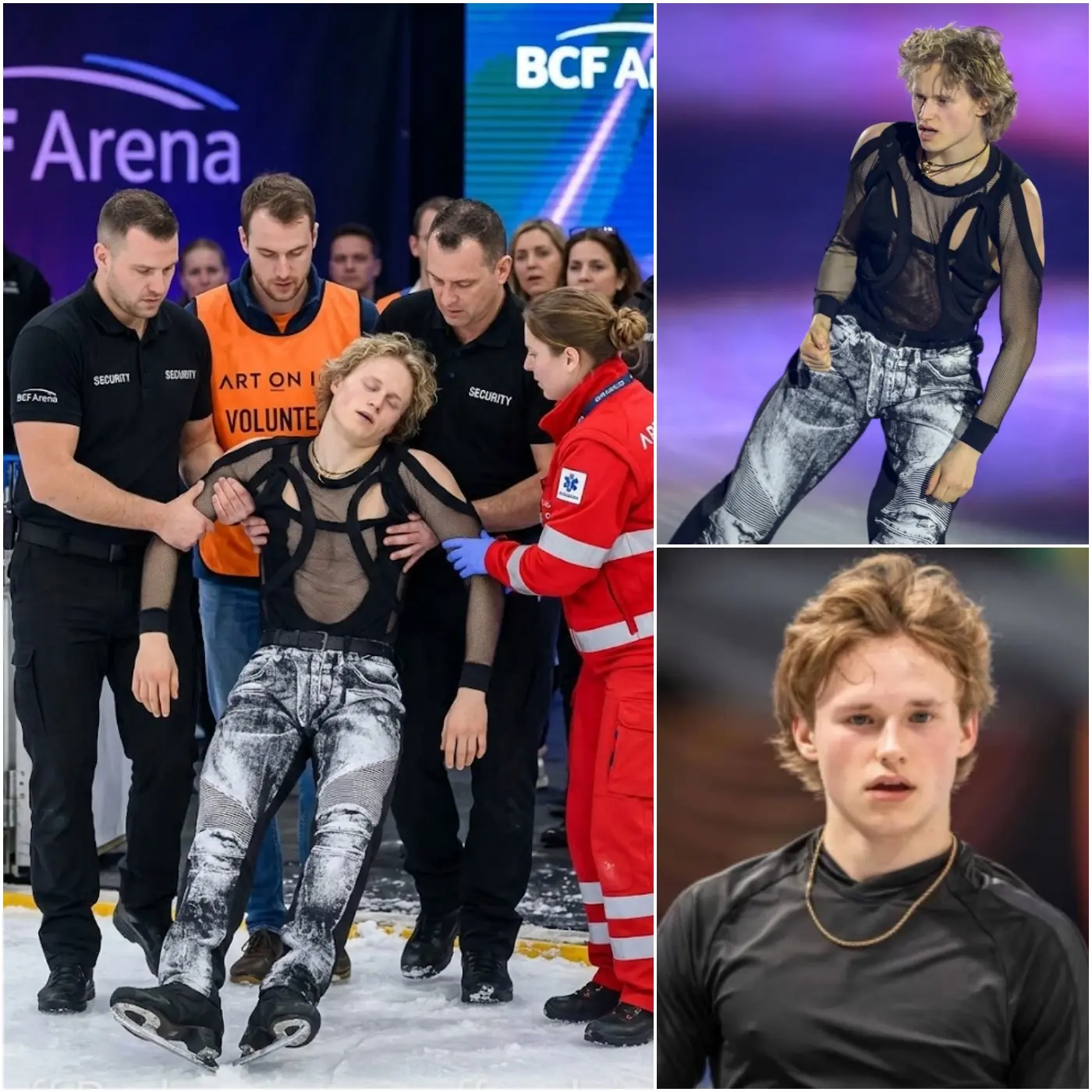
Freiburg, Switzerland – March 3, 2026. The BCF Arena, transformed for the occasion into a stage of sparkling ice and impressive lights, experienced one of the most dramatic moments in the recent history of figure skating. During the first night of the Freiburg leg of Art on Ice 2026, the world’s most prestigious exhibition tour on ice, Ilia Malinin, the 18-year-old Georgian-American phenom and world record holder for the quadruple Axel, collapsed to the ground just as she concluded one of her most ambitious routines.
The program in question was a revised version of NF’s “Fear,” the same piece with which he had shocked the world during the Milan-Cortina Olympic exhibition gala a few weeks earlier. Malinin had already performed an almost perfect sequence: a clean quadruple Axel at the exit, followed by a 4T+3A+Eu combination and a series of triple jumps with impossible entry variations. The audience was ecstatic, with applause after each element. Then, at the end, while he was preparing the last backflip that had made his shows in Zurich go viral, his body gave up.
A sudden collapse of the legs. Malinin tried to correct his balance, but fell forward and hit his chest and face on the ice. The dull sound of impact froze the room. For an eternal moment he did not move. Then he tried to get up, but his arms were shaking. The audience, which until a second before was shouting his name, fell into a surreal silence. Only the hum of shovels on the ice and a few isolated sobs broke the air.
In a few seconds the ice was invaded. Security elements in yellow vests formed an immediate cordon to keep away the photographers and fans who stood up. The ISU doctors, present in force due to the high technical level of the route, came running with the portable stretcher. One of them immediately checked his vital signs, while another placed a precautionary cervical collar on him. The Art on Ice staff turned off the main lights, leaving only the emergency spotlights and soft stage lights.

Yuma Kagiyama and Shoma Uno, sitting in the front row among the artists, jumped up; Kaori Sakamoto covered her mouth with her hands, visibly surprised.
Ilia was carried off the ice on a stretcher, conscious but visibly disoriented. He raised a weak hand towards the audience, a gesture that provoked emotional and staccato applause. The live broadcast was immediately interrupted and replaced with a message: “Due to a medical incident, the program is temporarily suspended. We will inform you as soon as possible.”
The news spread like wildfire on social networks. #PrayForIlia and #GetWellIlia topped global trends in less than ten minutes. Fans around the world shared videos of the exact moment of the collapse, accompanied by messages of support and concern. Many recalled the enormous pressure Malinin endured after the Olympics: He placed eighth in the freestyle due to a mental breakdown during the competition, followed by a public confession about his struggles with anxiety, depression and exhaustion.
In the documentary announced on Instagram a few weeks ago, he stated: “Skating saved my life, but sometimes it’s also killing me.”
The Art on Ice organization published a first official note approximately an hour after the accident: “Ilia Malinin was transported to the hospital for examination. His condition is stable, but serious. The artist suffered a strong and minor head injury and signs of extreme exhaustion. He will remain under observation for the next 48 hours. The show has been suspended out of respect and to guarantee the safety of all athletes.”

Sources close to Malinin’s team confirmed that the collapse was not caused by an acute injury during the jump, but by a circulatory collapse related to dehydration, accumulated fatigue and psychophysical stress. Malinin has been competing and performing almost non-stop since the Olympic season: world championships, promotional tours, charity performances, documentary filming and now Art on Ice. His coach, Tatiana Tarasova, tearfully told Russian television: “He is an 18-year-old boy with the weight of the world on his shoulders. He needs rest, not applause.”
The world of figure skating is in shock. Figures such as Nathan Chen, Yuzuru Hanyu (who sent a private message to Ilia’s team) and Evgenia Medvedeva have posted stories of support. The ISU announced an internal investigation to verify whether protocols for monitoring the health of athletes during tours were respected. Numerous coaches and athletes have taken the opportunity to denounce the increasingly tight schedule and the psychological pressure that weighs on young talents.
Meanwhile, at the BCF Arena, the show resumed after a break of more than an hour, but the atmosphere remained heavy. The rest of the artists dedicated their performances to Ilia, with a minute of silence before the last block. The audience turned on their mobile phone flashlights, creating a sea of flickering lights that accompanied the skaters’ exit from the stage.
Now Ilia Malinin is in a Freiburg hospital, under constant surveillance. Doctors speak of “severe psychophysical exhaustion with suspicion of mild head trauma due to concussion.” It is not life-threatening, but recovery could take weeks, if not months. His team asked for privacy and canceled all appearances planned for the next stages of the tour (Davos and possible extra shows).
This accident is not just a sports drama. It’s a wake-up call for the entire figure skating movement: how much can a teenager last when the world considers him invincible? Ilia Malinin brought the quadruple Axel into the record books and revolutionized the sport with her technique and charisma. But tonight, on the ice of Freiburg, he reminded everyone that phenomena are also human.
The skating world holds its breath. And he waits for Ilia to get up, not to jump, but for himself.