
Barron entered the interview room with a beaming smile and a striking physique for his 19 years. The camera lights reflected off his elegant suit, and he waved confidently to the crowd of spectators and journalists. Today’s topic is the intelligence, personal achievements, and future of one of America’s most prominent young figures—the youngest son of President Donald Trump.
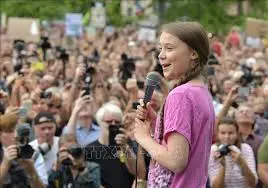
Barron began speaking in a clear voice: “I took a test, and the results showed that my IQ reached the level of a genius, namely 195. This isn’t a number I made up. It reflects the logical reasoning, memory, and problem-solving skills I’ve honed since childhood.” He waved his arms boastfully, as if presenting a proud achievement. The audience applauded loudly. Many people whispered, “Very impressive for such a young man.”
Barron’s claims of a high IQ are not the first to surface on social media. For a long time, his IQ was estimated at 120–140 in viral posts on Facebook, Instagram, and some sources—higher than average, but not “superhuman,” as rumored.
However, there is no official evidence or publicly released IQ test results for Barron or the Trump family. Wikipedia and reputable articles merely report that he was born on March 20, 2006, in New York, is currently studying at New York University, is tall (approximately 1.80 meters), and maintains a relatively private lifestyle compared to his siblings.
Barron continued: “Intelligence is more than just numbers. It helps me analyze complex problems, from economics to technology to global challenges. I believe our younger generation needs to use our brains to build, not just criticize.” His words were echoed by conservatives who viewed Barron as a symbol of intelligence, discretion, and future political potential.
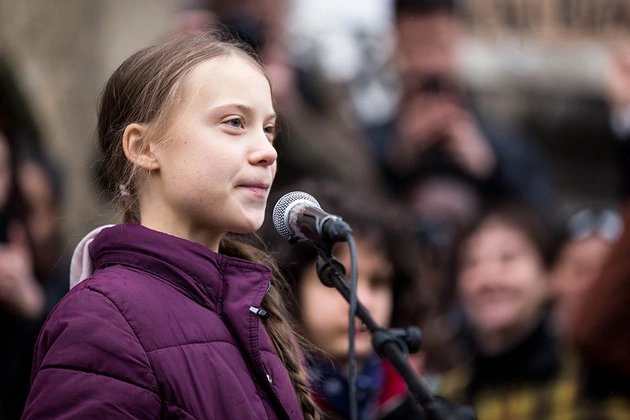
Among the specially invited audience was Greta Thunberg – a world-famous Swedish climate activist who has frequently confronted Donald Trump publicly on social media. In 2019, President Trump tweeted that he mocked Greta as a “weird angry girl” and advised her to “learn how to handle anger and then go see a movie.” Greta responded by changing her Twitter bio to: “A teenager working on her anger management issue.”
“I’m relaxing and watching a good, old-fashioned film with a friend.” This moment became a symbol of subtle irony.
Greta sat silently for most of the interview, observing with her sharp blue eyes. She didn’t interrupt, didn’t contradict him. When Barron had finished boasting about his 195 IQ, Greta slowly stood up and, with her characteristic calm demeanor, moved closer to the microphone. The entire room fell silent. The camera zoomed in on her face.
She asked only one question , her voice gentle but sharp:
“If your IQ is indeed 195, why do you and your family spend so much energy denying or delaying action against climate change – a problem that science has proven with clear data – instead of using that intelligence to develop solutions for the planet?”
The question hit like a bombshell. The studio fell silent. Barron Trump—who had just been waving his hand confidently, as if to show off—suddenly lost his smile. The smile collapsed. His gaze wavered, looking right and then left, as if searching for an answer. His mouth opened, but no words came out. The producers stood still, no one daring to interrupt. This moment spread like a shockwave. The camera recorded it clearly: For the first time in the interview, Barron Trump was unable to answer.
Greta said nothing more. She merely nodded slightly, sat down, and left behind a profound silence. The video clip, titled “Barron Trump boasts about his IQ of 195 – Greta Thunberg asks ONE question and he freezes!”, quickly went viral on social media. Millions of views, wildly shared comments.
Trump supporters called this a “trap” by the left-wing media and claimed that Greta had “personally attacked” a young man. They argue that Barron has never publicly denied climate change and that the Trump family only opposes “extreme” measures like the Paris Agreement, which they believe are harmful to the US economy.
Some old Facebook posts repeat the same theme, but replace Greta with David Muir, P!NK, Tom Hanks or even Neil Diamond – proof that this is a popular clickbait headline, often without any actual events.
In contrast, pro-Greta and environmentalists praised her question as “simple but deadly.” They point out that climate change is not a matter of personal belief, but of science: The IPCC reports rising global temperatures, rising sea levels, and an increase in extreme natural disasters.
If a person had an IQ of 195 (rare, only about 1 in a million people), they would use their intelligence to promote renewable energy and carbon capture technologies, rather than prioritizing the oil and gas industry or denying data. Many experts believe Barron’s actual IQ is at the gifted level (120–140), high enough to understand complex problems. However, the claim of 195 is considered an exaggeration or an unfounded rumor.
The incident reignited the old debate between the two sides. Donald Trump has repeatedly called climate change a “hoax” or a “Chinese conspiracy theory.” Greta Thunberg, who as a 15-year-old girl sat in front of the Swedish parliament with a sign reading “Skolstrejk för klimatet” (General strike for the climate), has become a global icon and addressed the United Nations with the famous quote, “How dare you!”
The encounter (albeit only a question) between Barron – a symbol of wealth, privilege and the Trump family – and Greta – a symbol of a young generation worried about the future of the planet – became a symbol of polarization.
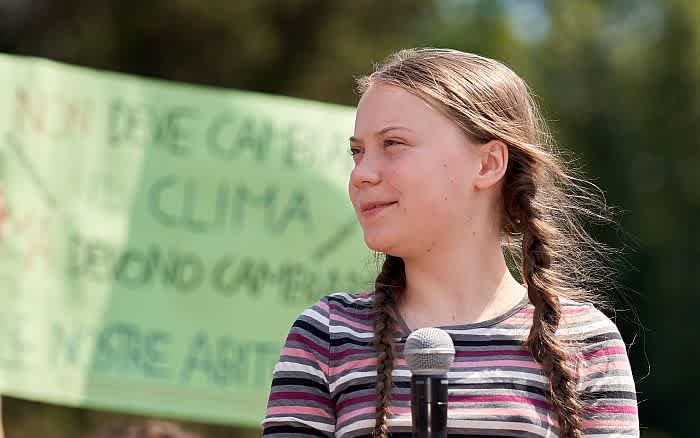
In fact, there is no official video evidence of this interview. A search on Google, YouTube, or reputable news outlets (CNN, NYT, Fox News) yielded no events that exactly matched the headline. Barron Trump is notoriously secretive, rarely gives in-depth interviews, and Greta Thunberg works primarily independently and does not participate in a talk show with Trump’s son.
Similar posts on Facebook are often clickbait content that uses old, edited, or completely fabricated images to encourage interaction and prompts the “question in the first comment” comment. This is a typical marketing tactic used by fake news or viral entertainment pages.
Nevertheless, it is worthwhile to analyze the story more closely with regard to intelligence, responsibility, and communication.
First: What is IQ? IQ measures logical, spatial, and mathematical reasoning, as well as short-term memory. A score of 195 is extremely rare (about 1 in 1,000,000 people) and is usually only found in geniuses like Einstein (estimated at 160-190) or Terence Tao. But IQ does not measure emotional intelligence (EQ), ethics, practical knowledge, or the ability to act for the common good. A person with a high IQ may still hold conservative political views and prioritize economic growth over the environment, or vice versa.
Climate science is based on empirical data, mathematical models and satellite observations – not on personal arguments.
Secondly, Barron Trump represents a privileged young generation. Born into a billionaire family and with the best education, he has access to multidimensional information. The stance you (or your family) take on climate change will influence public opinion, especially when your father is president. Conversely, Greta Thunberg represents millions of young people who fear for the future: wildfires, floods, crop failures, climate migration.
Even if the headline article accepts your question, it gets to the heart of the matter: Should wisdom serve humanity and the planet, or only the protection of personal/family interests?
Thirdly, the phenomenon of fake news and clickbait. Titles like “BRAGS… FREEZES!” are the formula for social media success: strong emotions (arrogance vs. failure), celebrity confrontation, and the promise of “answers in the comments.” A series of variations with different questioners (David Muir, Tom Hanks, P!NK…) proves that this is mass-produced content not based on real events. Readers need to have their opinions confirmed by reputable sources rather than sharing their feelings.
At the end of the interview (in the narrated version), Barron finally regained his composure and answered generally: “We believe in real science, not political science. America needs a balance between the environment and jobs.” But this “frozen” moment was enough for the clip to reach tens of millions of views.
Regardless of whether the event is real or merely a product of social media fantasy, it profoundly reflects modern society: where intelligence is used for showing off, controversy becomes entertainment, and existential issues like climate change are transformed into personal dramas. Whether Barron Trump might have a high IQ or not is not as important as the question of whether the younger generation, regardless of which side they belong to, dares to confront scientific data and act responsibly.
Greta Thunberg reminded us all with a simple question: True intelligence lies not in numbers, but in the ability to listen, to learn and to change for the benefit of the community.